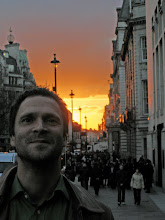
L'Allegro (at last)
Milton fans among you (?) would have seen this one coming, but none of us would have expected it to have taken quite so long. When I was embracing my inner melancholic (what do I mean inner?), and attempting to find some virtue in the climate that has seeped soddenly into our souls, I was hoping to flip it over as soon as the sun shone. As soon as the sun shone.... erhem.... But then it didn't, and it didn't and it didn't. And then it did, but I, of course was not here, was in fact selflessly suffering grey skies in Spain so we could have sun here. But now it is shining, and has been for about 4 whole days. So all is well with the world, and I'm walking on sunshine. Which prompts me to complete my dreary diptych on climate and creativity.
Sunshine may very well not be so conducive to art as rain is in this country. Walking on Sunshine (which is by a British band), is a lovely record. It perfectly sums up a sentiment in a burst of aural glee, with bouncy brass as yellow and shining as the old current bun itself. But no one could accuse it of being art. Club Tropicana - fun and sunshine, there's enough for everyone - is to, say Morrissey's rain-soaked melancholic musings, what a Club 18-30 holiday brochure is to Gerald Brenan's South of Granada, or Laurie Lee's As I woke up one Midsummer Morning (about the Costa del Sol before a hotel appeared). The Wham! (the ! says it all) song and video, is of interest principally to testify to our naivety back then in believing George Michael had even a passing interest in the ladies.
Sunshine turns our heads, and turns off our creativity. Perhaps. But not entirely. For a start, old habits die hard. Shelley's poem, 'Stanzas Written in Dejection Above the Bay of Naples' is a case in point. which opens: 'The sun is warm, the sky is clear, / The waves are dancing fast and bright,/' And describes a scene a travel brochure copywriter would weep to be able to describe. But old Percy B. continues:
Alas, I have nor hope nor health
Nor peace within nor calm around,
Nor that content surpassing wealth...
Nor fame nor power nor love nor leisure -
Others I see whom these surround,
Smiling they live and call life pleasure:
To me that cup has been dealt in another measure.
Good grief. Pull yourself together man. Stanzas written in dejection above a slag heap in Bolton I can accept. Spring 1818, Keats spent in Devon with his dying brother Tom. They had hoped to be in Lisbon, but couldn't afford it. It appears to have rained every day for about 6 weeks. Shelley, loafing above the bay of Naples on a sunny day, looking on one of the most glorious sights in Europe still, is feeling sorry for himself. And as for not having leisure. An Etonian aristocrat whose idea of a day's work was wearing a big blouse and penning a few grumpy lines while on permanent holiday (sorry exile from the political oppression of Britain) has no sympathy from me. But it does show you how deep the melancholy runs. It takes a while for the clouds to burn off.
It didn't take David Hockney long, if I may stray into another medium. He flits off to America in 1961, and comes to live there in 1963 drawn to southern California. 1963 is the year Summer Holiday came out, during the worst winter of the 20th century. When Cliff was singing about going where the sun shines brightly, and going where the sea was blue, our David was delighting in those very things, slapping 'em down in pure acrylic colour and turning the dream into art. We can do it. Grey misery might spur us into art, and, on the whole forge finer productions; yet it also spurs us into a desperate need to escape. And when we do escape we have eyes ready to see it and souls ready to engage with what we see. Like sunflowers kept in cellars, we only need someone to open to door to make us shine...
Right. That's quite enough pretentious bombast for one day. There are some sunbeams out there with my name on them, and the only canvas I'm going to be colouring today is the one stretched on my scrawny frame. Exits stage left humming Walking on Sunshine.
Saturday, October 11, 2008


Wednesday, August 13, 2008
Il Penseroso
I have to accept that summer is officially cancelled, and winter has queue-jumped autumn, and must put a brave face on it. Actually, no, that is simply beyond me. But instead of unloading a torrent of righteous indignation as the heavens deliver theirs of cold, wet, windy despair, or instead of muttering a plaintive elegy over this stillborn summer, I will attempt a more philosophical perspective on these circumstances. No easy task, but here goes...
I was led to pursue this line by a response to my last blog from anonymous (whom I darkly suspect of hailing from sunnier climes), that fine weather doesn't produce the best poems. The implication is that grey skies and creativity might be more conducive bedfellows, and that this is somehow a silver lining to the brooding bleakness enveloping us (me) at present. Might there be something in this? Sidestepping poetry for the moment, pop music does lend some support to this notion. Jeremy Paxman suggests something of the kind in his book, The English - when he proposes the “reasonable supposition that cold wet weather, which forced teenagers to stay indoors in winter instead of going to the beach or skiing, probably has something to do with the country’s capacity for inventive rock music”. But we can go even further, not just pop music per se, but miserable pop music. The British didn't invent pop music, and didn't really invent many strains of it. We are particularly good at adapting it, giving it a particularly edgy feel and sound, and adding lyrical genius. And if you look at what is characteristic about what we contribute to the pop canon, and, more significantly, what is most successful as an export, a discernible and distinctive trait sums this up - misery. We are maestros of musical melancholy, and frankly, who can wonder in this climate?
I'm serious. If you think about it, there's an awful lot of misery in British pop, and especially the most successful exports. The obvious one is Goth. One of the few truly home-grown British pop product lines, it is a highly successful global export of long-standing, and Alien Sex Fiend ought to be given the Queen's Award For Industry for what they spawned 25 years ago. And then there is Morrissey. I don't know of a single male Italian of a certain age, who does not worship Morrissey and the Smiths. There's one who lives down below me, who will spend warm sunny days (when we had them) in doors, listening to tales of rainy Salford, and finding this exotic and beguiling. The rain falls hard on a humdrum town, and a good part of the globe (and generally the sunnier parts of it), lap that rain up by the bucketload. It is particularly ironic that Morrissey moved to LA and then latterly Rome, but it doesn't stop him singing about the 'slate grey Victorian skies' he left behind, and which those in his adopted home find strangely enticing. Radiohead don't sing about the weather (I'm not sure what they sing about, to be honest), but they look and sound like they've spent their whole lives starring out the window at rain, and they are, I'm told, the most successful band to break America since the Beatles. Hmm. I suppose the Beatles weren't miserablists at first, not in their mop-top, happy, jangly days; but it's interesting to see what America produced to meet the threat of the British invasion. What could they do to meet the challenge of muddy Mersey merriment? Hit back with sunshine. The Beach Boys, the Byrds, and then the whole San Fran scene, until sunshine won the battle, and the Beatles themselves joined the hippie trail to the sun. Depeche Mode - started off as electrobubblegum popsters, and delighted few outside these shores - got darker, darker still, so dark the lead singer tastes death momentarily - and they're an international sensation, while they can scarcely get arrested at home.
So, what does this suggest? Simply, that our climate cultivates mouldy misery, that more fortunate cultures enjoy like rich truffles, damp with our despair. This is a silver lining of a kind, I suppose. But I ain't seeing any of the royalties.